How Fourier's 200-Year-Old Heat Equation Powers AI Image Generati
The mathematics behind AI image generators like Stable Diffusion traces back to Joseph Fourier's 1822 heat equation. Understanding diffusion processes reveals how these models transform noise into coherent images.
When you prompt Stable Diffusion or DALL-E to generate an image, you're witnessing a remarkable collision between 19th-century physics and cutting-edge machine learning. The mathematical framework that transforms random noise into photorealistic images has its roots in work done by French mathematician Joseph Fourier in 1822—long before anyone could imagine computers, let alone artificial intelligence.
The Heat Equation: Where It All Began
Joseph Fourier was obsessed with understanding how heat spreads through materials. His groundbreaking insight was expressing this phenomenon mathematically: heat diffuses from hot regions to cold ones, gradually evening out temperature differences until equilibrium is reached. The heat equation he developed describes this process with elegant precision.
What makes this relevant to AI? The same mathematical principles that describe heat spreading through a metal rod also describe how information—or in our case, image structure—can be systematically destroyed and, crucially, reconstructed.
From Heat to Noise: The Diffusion Process
Modern diffusion models like Stable Diffusion, DALL-E 2, and Midjourney exploit this mathematical framework in a clever two-phase approach. The forward diffusion process is conceptually simple: take a real image and gradually add Gaussian noise to it, step by step, until the original image is completely obscured. What remains is pure random noise—statistical chaos with no discernible structure.
This forward process is mathematically equivalent to heat diffusion. Just as a hot spot gradually spreads and cools until temperature is uniform, the concentrated information in an image gradually disperses until it becomes statistical noise. The heat equation's mathematics describe both processes identically.
Conquering Chaos: Learning to Reverse Entropy
The revolutionary insight of diffusion models is that this process can be reversed. If we can learn the precise noise that was added at each step, we can subtract it, gradually recovering structure from chaos. This is where neural networks enter the picture.
During training, diffusion models learn to predict the noise component at any given step of the forward process. Given a noisy image and a timestep indicator, the model estimates what noise was added. This learned denoising capability becomes the key to generation: start with pure noise and iteratively remove predicted noise, gradually revealing a coherent image.
The mathematical formulation relies on score matching—the model learns the gradient of the log probability distribution of the data. This connects directly to Fourier's original framework: the score function tells us which direction to move in image space to increase probability, just as temperature gradients tell us which direction heat will flow.
Why Diffusion Models Outperform Alternatives
Previous generative approaches like GANs (Generative Adversarial Networks) and VAEs (Variational Autoencoders) struggled with training stability and mode collapse—tendencies to generate limited variations or produce artifacts. Diffusion models sidestep these issues through their mathematical grounding.
The iterative denoising process provides a stable training objective: simply predict the noise at each step. There's no adversarial dynamics to balance, no complex latent space to optimize. The heat equation's well-understood mathematics provides theoretical guarantees about convergence and sample quality.
Furthermore, the multi-step generation process allows for classifier-free guidance—the ability to steer generation toward text prompts without requiring separate classifier models. This is why text-to-image synthesis has become so effective: the diffusion framework naturally accommodates conditional generation.
Implications for Synthetic Media Detection
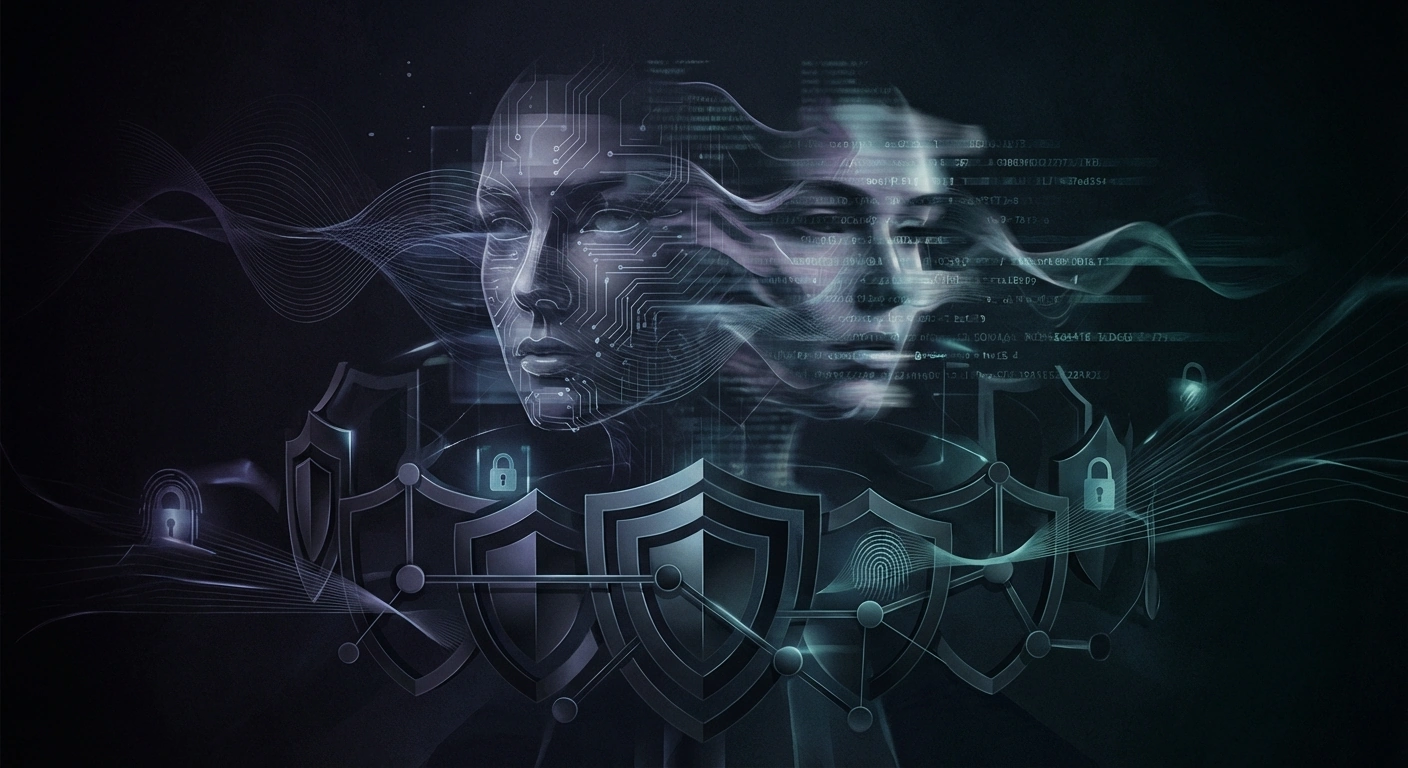
Understanding diffusion's mathematical foundations has direct implications for deepfake detection and content authenticity. The iterative denoising process leaves statistical fingerprints that differ from both real photographs and images generated by other methods.
Researchers are developing detection methods that exploit the specific noise patterns and frequency characteristics introduced by the diffusion sampling process. Because the generation follows a mathematically defined trajectory through noise space, artifacts can be characterized and identified—though this remains an active arms race as models improve.
The Elegant Connection
What Fourier couldn't have known is that his heat equation would become foundational to generating synthetic images two centuries later. The mathematics of equilibrium-seeking processes—whether heat, particles, or pixel values—follows universal principles that machine learning has learned to exploit.
When you generate an AI image, you're watching a neural network trace Fourier's mathematical path in reverse: starting from maximum entropy (pure noise) and systematically reducing it, guided by learned patterns, until coherent structure emerges from chaos. It's a testament to the universality of mathematical principles that a tool designed to understand furnaces now powers the creation of synthetic media.
As diffusion models continue advancing—with faster sampling methods, higher resolutions, and video generation capabilities—Fourier's fundamental insight remains at the core: information, like heat, follows predictable mathematical laws, and understanding those laws lets us control both destruction and creation.
Stay informed on AI video and digital authenticity. Follow Skrew AI News.