Why Embeddings Make LLMs Seem Intelligent: A Technical Primer
The famous equation 'King - Man + Woman = Queen' reveals how embeddings capture semantic meaning in vector space, forming the foundation of why large language models appear intelligent.
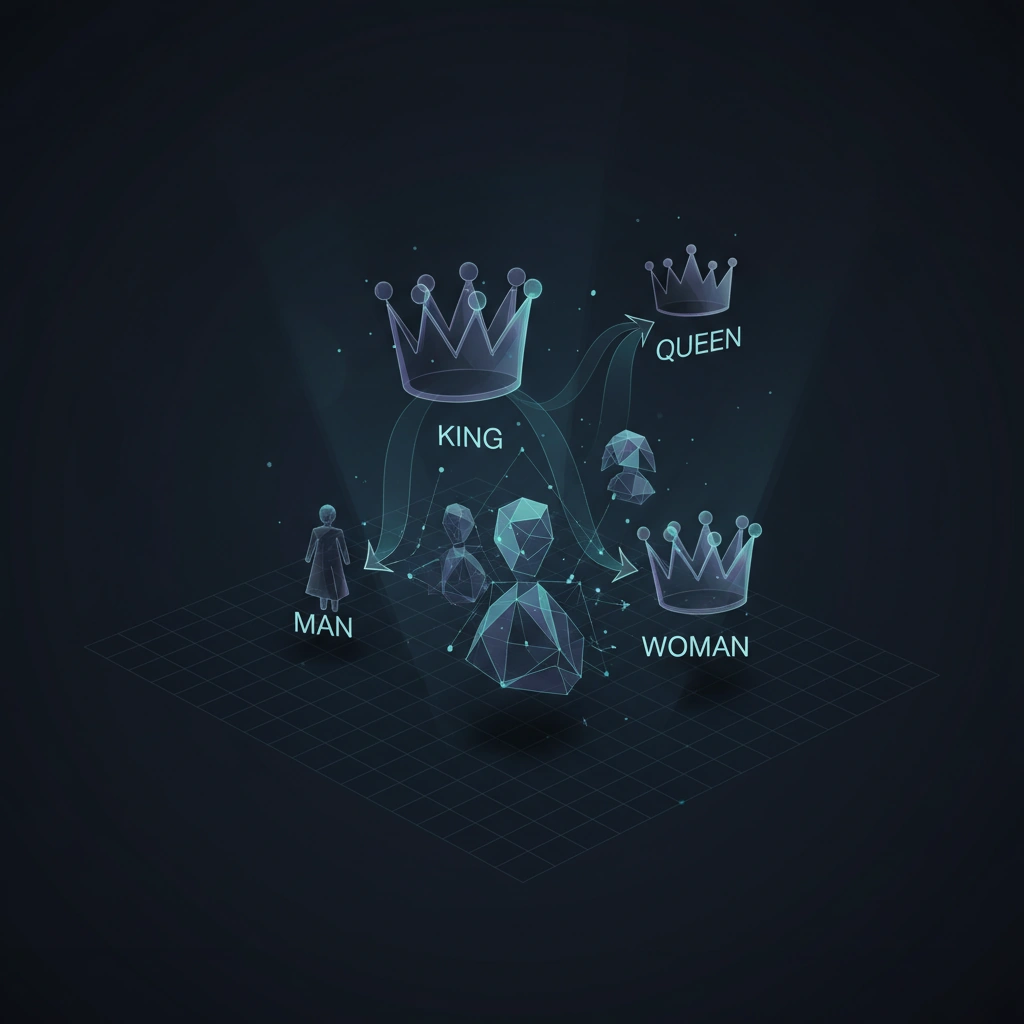
At the heart of every large language model—from ChatGPT to the AI systems generating synthetic media—lies a deceptively simple yet powerful concept: embeddings. These numerical representations of words and concepts are arguably the most crucial innovation that makes modern AI feel genuinely intelligent, and understanding them is essential for anyone working with generative AI technologies.
The Famous Equation That Changed AI
The equation King − Man + Woman = Queen isn't just a clever mathematical trick; it's a demonstration of how embeddings capture the essence of human language in a way that machines can manipulate mathematically. This discovery, emerging from early word2vec research, showed that vector representations of words could encode semantic relationships—and this breakthrough underpins virtually everything we see in modern AI generation.
When we convert the word "King" into a vector (a list of numbers representing its position in high-dimensional space), that vector encodes not just the word itself but its relationships to other concepts. Subtracting the "Man" vector removes masculine associations, and adding the "Woman" vector introduces feminine ones. The result? A vector that lands remarkably close to "Queen" in this mathematical space.
How Embeddings Actually Work
Think of embeddings as coordinates in a vast conceptual map. In this space, words with similar meanings cluster together. "Happy," "joyful," and "elated" occupy nearby positions, while "sad" sits in a distant region. But the real power comes from the directions between these points, which encode relationships.
The direction from "man" to "woman" represents the concept of gender. The direction from "Paris" to "France" represents the capital-of relationship. These directions are consistent across the space, meaning you can apply the same transformation to "Tokyo" and arrive near "Japan." This geometric consistency is what makes embeddings so powerful for reasoning about language.
The Training Process
Embeddings are learned through exposure to massive text corpora. The training process adjusts these vectors so that words appearing in similar contexts develop similar representations. A neural network processes billions of sentences, gradually refining its internal map until semantic relationships emerge naturally from the data.
Modern embedding dimensions typically range from 512 to 4096 numbers per word or token. Each dimension captures some aspect of meaning—though individual dimensions rarely correspond to interpretable concepts. The meaning emerges from the collective pattern across all dimensions.
Why This Matters for Generative AI
Every generative AI system—whether it's producing text, images, audio, or video—relies on embeddings as its fundamental language. When a diffusion model generates an image from a text prompt, it first converts that prompt into embeddings that guide the generation process. When an LLM predicts the next word, it's navigating through embedding space to find contextually appropriate continuations.
For synthetic media specifically, embeddings enable the semantic control that makes modern generation so powerful. Want to modify an image to change someone's expression? That operation works by manipulating embeddings in directions corresponding to emotional concepts. Voice cloning systems use speaker embeddings that capture the unique characteristics of a person's voice in vector form.
The Connection to Deepfakes
Understanding embeddings helps explain both the capabilities and limitations of deepfake technology. Face-swapping systems use identity embeddings—vector representations that encode a person's facial features. The quality of a deepfake depends heavily on how well these embeddings capture and transfer identity information.
Detection systems also leverage embeddings. Many deepfake detectors analyze whether visual embeddings contain artifacts inconsistent with authentic footage. The arms race between generation and detection largely plays out in embedding space.
Beyond Words: Multimodal Embeddings
The same principles extend beyond text. CLIP and similar models create aligned embedding spaces where images and text share the same coordinate system. A photo of a cat and the phrase "a cat" map to nearby points, enabling text-to-image generation, image search, and multimodal AI assistants.
This unification of modalities through shared embedding spaces is what enables the current explosion in AI-generated content. Whether you're prompting for text, images, audio, or video, the underlying process involves navigating and manipulating these learned vector representations.
The Illusion of Intelligence
Do embeddings give AI genuine understanding? The answer remains philosophically complex. What's clear is that embeddings enable functional understanding—the ability to manipulate concepts, draw analogies, and generate coherent outputs. Whether this constitutes "real" intelligence may matter less than recognizing the profound capabilities these representations enable.
For practitioners in synthetic media and AI video, embeddings aren't just theoretical concepts—they're the tools that make modern generation possible. Understanding them deeply provides insight into both the remarkable capabilities and inherent limitations of the AI systems reshaping how we create and consume media.
Stay informed on AI video and digital authenticity. Follow Skrew AI News.



