Deep Agents: Solving Multi-Step AI Agent Failure Modes
AI agents often fail after several steps due to error compounding and context degradation. Deep Agents architecture introduces new mechanisms to maintain coherence across extended task execution.
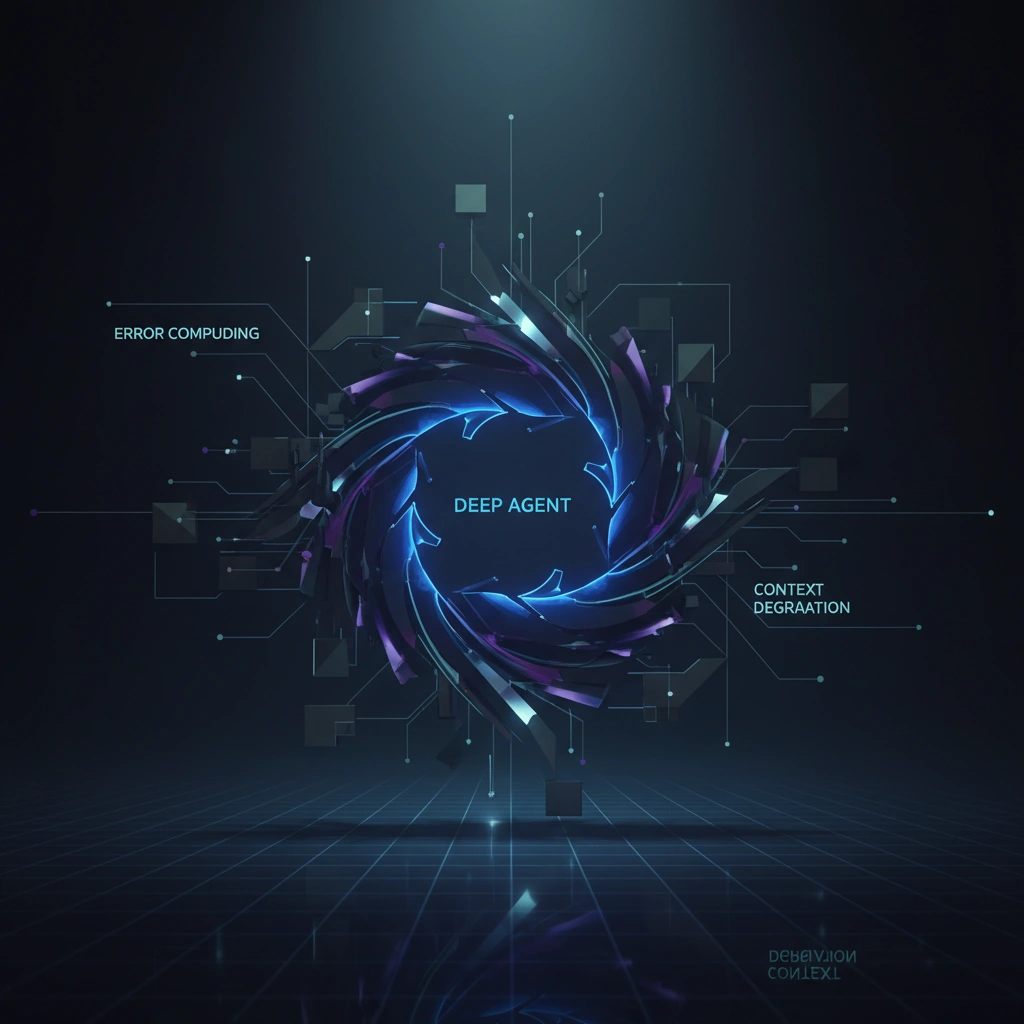
If you've worked with AI agents—whether for automated video editing pipelines, content generation workflows, or complex multi-step reasoning tasks—you've likely encountered a frustrating pattern: the agent performs brilliantly for the first few steps, then gradually degrades until it produces nonsensical outputs or fails entirely. This phenomenon, sometimes called agent drift, represents one of the most significant barriers to deploying reliable autonomous AI systems.
Understanding Why AI Agents Fail
The fundamental problem lies in how traditional AI agents handle sequential task execution. Each step in an agent's workflow produces outputs that feed into subsequent steps, creating a chain of dependencies. When errors occur—even small ones—they compound exponentially across the execution pipeline.
Error compounding happens because language models make probabilistic predictions. A 95% accuracy rate sounds impressive until you realize that across 20 steps, your cumulative success probability drops to roughly 35%. By step 50, you're looking at near-certain failure. This mathematical reality explains why agents that excel at simple tasks collapse when faced with extended workflows.
Beyond pure error accumulation, agents suffer from context degradation. As context windows fill with intermediate outputs, relevant information gets pushed out or diluted. The agent loses track of the original objective, the constraints it should respect, and the reasoning that guided earlier decisions. This manifests as outputs that are locally coherent but globally incoherent—the agent forgets what it was trying to accomplish.
The Deep Agents Architecture
Deep Agents represents an architectural approach designed specifically to address these multi-step failure modes. Rather than treating agent execution as a simple sequential chain, Deep Agents introduces several key mechanisms that maintain coherence and reliability across extended task execution.
Hierarchical Goal Decomposition
Deep Agents implements hierarchical goal structures that preserve the relationship between high-level objectives and low-level actions. Instead of flattening complex tasks into linear step sequences, the architecture maintains a tree structure where each subtask explicitly references its parent goal. This allows the agent to continuously verify whether its current actions serve the original objective.
When context limits force pruning of intermediate information, the hierarchical structure ensures that goal-relevant context receives priority over execution details. The agent might forget exactly how it performed step 15, but it never loses sight of why step 15 mattered.
State Verification Checkpoints
Traditional agents operate in an open-loop fashion—they execute steps without verifying that previous steps succeeded correctly. Deep Agents introduces verification checkpoints that validate system state against expected conditions before proceeding.
These checkpoints don't merely check for obvious failures. They employ separate verification models that assess whether the current state is consistent with the stated goals and constraints. If drift is detected, the system can backtrack to a known-good state rather than propagating errors forward.
Memory Consolidation Mechanisms
Perhaps most innovative is Deep Agents' approach to memory consolidation. Drawing inspiration from how biological memory systems work, the architecture periodically consolidates intermediate results into compressed representations that capture essential information while discarding irrelevant details.
This consolidation process uses dedicated summarization and extraction models that identify what information from recent steps must be preserved for future reasoning. The result is a working memory that remains manageable in size while retaining the semantic content needed for coherent long-horizon execution.
Implications for AI Video and Content Generation
For synthetic media applications, these architectural advances matter enormously. Consider an AI video generation pipeline that must maintain character consistency across dozens of scenes, respect narrative constraints established early in the process, and coordinate multiple generation subsystems. Traditional agent architectures struggle with exactly this kind of extended, constraint-heavy workflow.
Deep Agents-style architectures enable more reliable autonomous content pipelines where AI systems can execute complex creative workflows with minimal human intervention. A video generation agent could maintain consistent character appearances, voice characteristics, and narrative elements across extended productions—exactly the capabilities needed for scaled synthetic media production.
Detection and Authenticity Implications
Interestingly, these advances also affect the authenticity verification landscape. More reliable AI agents can produce more consistent synthetic content, potentially making some existing detection approaches less effective. Detection systems that rely on identifying inconsistencies within AI-generated content may need to evolve as generation systems become better at maintaining coherence.
Conversely, verification systems themselves can benefit from Deep Agents-style architectures. Multi-step verification pipelines that analyze content across multiple modalities and timeframes face similar reliability challenges. More robust agent architectures enable more thorough automated authentication workflows.
Looking Forward
The transition from simple chain-of-thought agents to sophisticated architectures like Deep Agents represents a maturation of the AI agent field. As these systems become more reliable, we should expect increased deployment in production environments—including content generation, video editing, and media authentication systems.
The key insight from Deep Agents research is that reliability isn't just about better base models—it requires architectural innovations that account for the unique challenges of extended autonomous execution. For practitioners building AI-powered media pipelines, understanding these failure modes and solutions is increasingly essential.
Stay informed on AI video and digital authenticity. Follow Skrew AI News.