Building AI Video Agents: A 2026 Developer's Guide
Agentic video generation is reshaping how developers build AI video pipelines. This guide breaks down the architecture, orchestration, and tooling behind autonomous AI video agents heading into 2026.
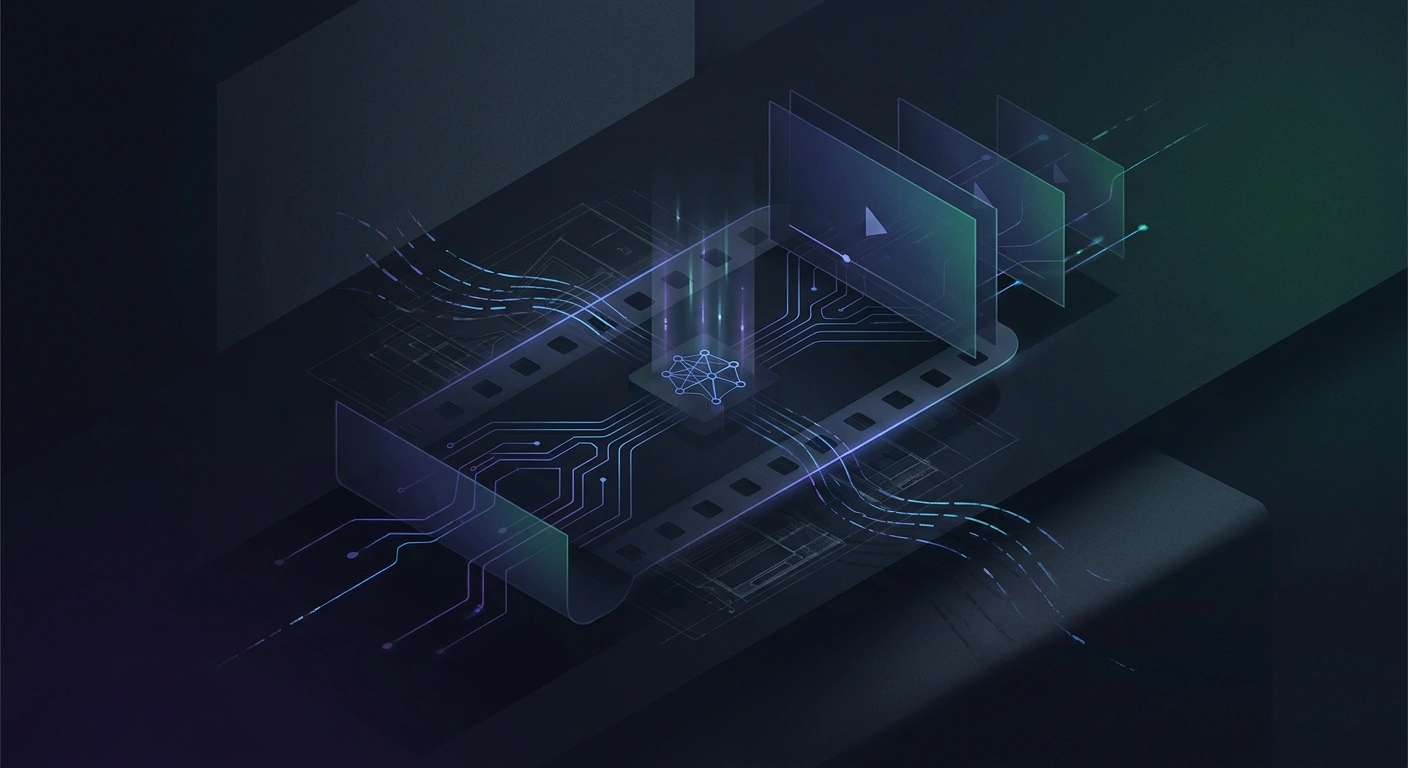
As generative video models mature past the novelty stage, the frontier of development in 2026 is shifting from single-shot text-to-video prompts toward agentic video generation—autonomous systems that plan, generate, evaluate, and refine video content across multiple steps. This developer-focused guide explores how AI video agents are architected and why the agentic paradigm is becoming the dominant pattern for production-grade synthetic media pipelines.
From Prompts to Pipelines
Traditional text-to-video generation treats a single prompt as the entire interface: the user describes a scene, and a diffusion or transformer-based model returns a clip. While models like Sora, Runway Gen-3, Kling, and Veo have dramatically improved fidelity and temporal coherence, they still operate as monolithic black boxes. The results can be impressive, but they are difficult to control, iterate on, or compose into longer narratives.
Agentic video generation reframes the problem. Instead of a single call, an AI video agent decomposes a high-level goal—say, "produce a 60-second product explainer"—into a sequence of coordinated subtasks: script generation, shot planning, scene-by-scene video synthesis, voice cloning or narration, music selection, and final assembly. Each stage is handled by a specialized tool or model, orchestrated by a reasoning layer, typically a large language model, that maintains state and makes decisions about what to do next.
Core Architecture of a Video Agent
At a structural level, most agentic video systems share a common set of components:
- Planner/Orchestrator: An LLM (or a fine-tuned reasoning model) that interprets the user goal, breaks it into steps, and routes tasks to the appropriate tools. This is the "brain" of the agent.
- Tool layer: A collection of callable functions—text-to-video APIs, image generators, TTS and voice-cloning engines, upscalers, and editing utilities. These are exposed through a standardized interface so the planner can invoke them programmatically.
- Memory and state: Persistent context tracking generated assets, character consistency references, style guides, and prior decisions across the pipeline.
- Evaluator/Critic: A feedback loop—often another model—that scores intermediate outputs for prompt adherence, visual quality, or continuity, triggering regeneration when results fall below threshold.
This closed-loop design is what distinguishes an agent from a simple script. The evaluator enables self-correction, allowing the system to catch a mangled hand, an inconsistent character, or a scene that drifts from the brief and regenerate autonomously.
Solving Consistency and Continuity
One of the hardest problems in long-form AI video is maintaining consistency—of characters, lighting, color grading, and narrative logic—across many generated shots. Agentic systems tackle this by threading reference embeddings and style anchors through the memory layer. When a character appears in shot one, the agent stores identity references (via image embeddings or LoRA-style conditioning) and re-injects them into every subsequent generation call. This mirrors the workflow a human editor would follow, but automated.
For developers, the practical implication is that building a robust video agent is less about training a single massive model and more about orchestration engineering: managing API calls, handling failures gracefully, caching expensive generations, and designing prompt-templating systems that keep outputs coherent.
Implementation Considerations
Developers building these systems in 2026 face several concrete decisions. Model selection matters: some providers offer superior motion, others better prompt adherence or faster inference. A well-designed agent may route different shots to different models based on their strengths. Cost and latency are also central—video generation remains computationally expensive, so caching, parallelization, and selective regeneration are critical to keeping pipelines economical.
Frameworks originally built for text agents—tool-calling schemas, ReAct-style reasoning loops, and structured output parsing—are being adapted for multimodal video workflows. The emerging challenge is extending these patterns to handle large binary assets and long-running asynchronous jobs, since video generation can take minutes rather than seconds.
Authenticity Implications
The rise of autonomous video agents carries significant implications for digital authenticity. As pipelines become capable of producing fully synthetic, narratively coherent videos with cloned voices and consistent characters at scale and with minimal human oversight, the line between authentic and synthetic media grows blurrier. This makes provenance standards like C2PA and robust detection increasingly urgent. Developers building agentic systems should treat content labeling and watermarking not as afterthoughts but as first-class components of the pipeline.
Agentic video generation represents a meaningful architectural shift—one that turns generative models into building blocks within larger, self-directed systems. For developers, mastering orchestration, consistency management, and evaluation loops will be the defining skill set of the coming year.
Stay informed on AI video and digital authenticity. Follow Skrew AI News.