Multi-Agent AI Systems: CrewAI, LangGraph & Docker Guide
A comprehensive technical guide to building production-ready multi-agent AI systems using CrewAI for agent orchestration, LangGraph for workflow graphs, FastAPI for APIs, and Docker for deployment.
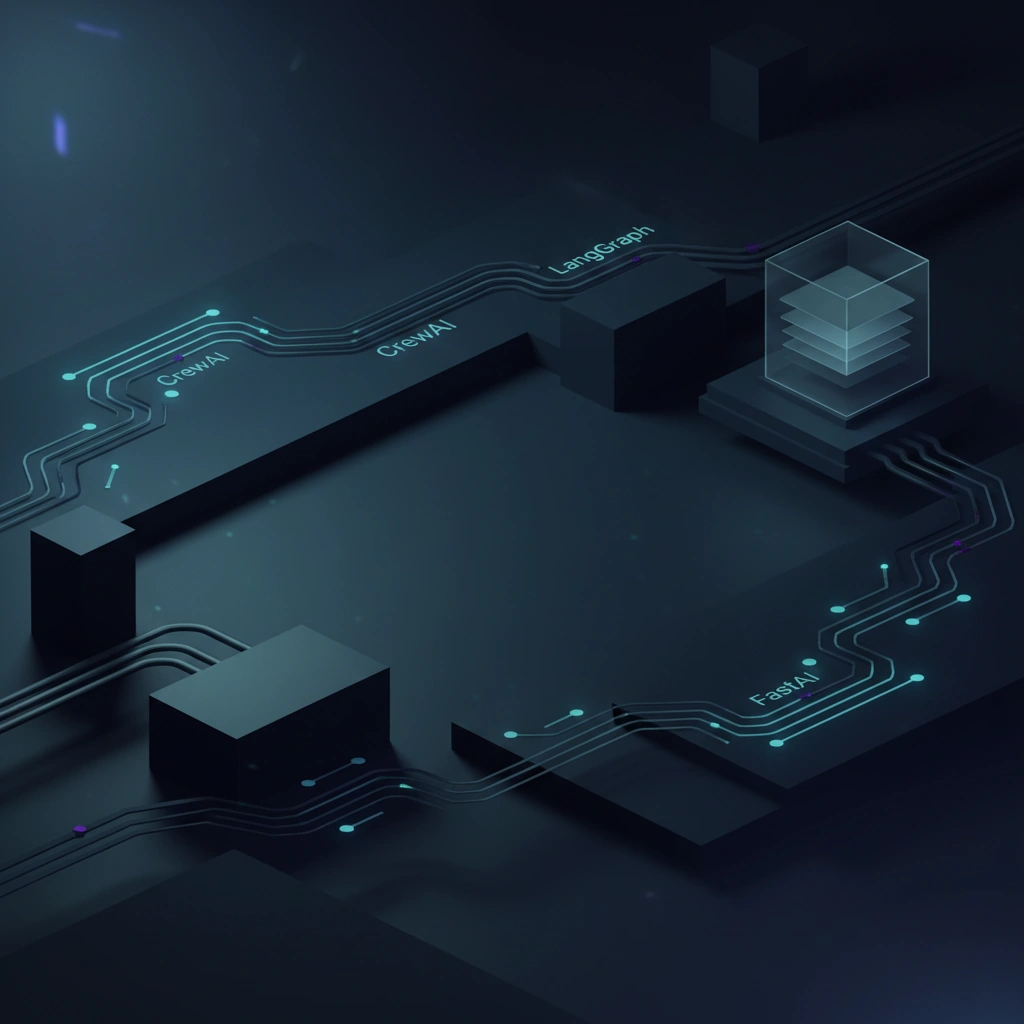
Multi-agent AI systems represent one of the most significant architectural shifts in how we build intelligent applications. Rather than relying on a single monolithic AI model, these systems orchestrate multiple specialized agents that collaborate, delegate, and reason together to accomplish complex tasks. A new comprehensive guide explores how to build production-grade multi-agent systems using four powerful tools: CrewAI, LangGraph, FastAPI, and Docker.
Understanding the Multi-Agent Architecture
The fundamental premise of multi-agent systems is task decomposition and specialization. Instead of asking one large language model to handle everything from research to analysis to writing, you create distinct agents with defined roles, tools, and capabilities. This approach mirrors how effective human teams operate—each member brings specialized skills while coordinating toward shared objectives.
CrewAI serves as the high-level orchestration framework, providing abstractions for defining agents, their roles, and how they collaborate. It handles the complex dynamics of agent communication, task delegation, and result aggregation. CrewAI's strength lies in its intuitive mental model: you define a "crew" of agents, assign them tasks, and let the framework manage their interactions.
LangGraph complements this by providing fine-grained control over workflow execution. Built on top of LangChain, LangGraph represents agent workflows as directed graphs where nodes are computational steps and edges define the flow of information. This graph-based approach enables complex conditional logic, parallel execution, and sophisticated state management that pure sequential pipelines cannot achieve.
Technical Implementation Details
The architecture typically begins with defining agent specifications. Each agent requires several key components:
Role Definition: A clear description of the agent's expertise and responsibilities. For example, a "Research Agent" might specialize in gathering and synthesizing information from multiple sources, while an "Analysis Agent" focuses on extracting insights and patterns from collected data.
Tool Assignment: Agents gain capabilities through tools—functions they can invoke to interact with external systems. This might include web search APIs, database connectors, file system access, or custom integrations. The tool abstraction is crucial because it extends agent capabilities beyond pure language generation.
Memory Configuration: Agents can maintain short-term conversational memory and long-term knowledge stores. This allows them to build context over interactions and learn from previous tasks, essential for systems that need to maintain coherence across complex multi-step operations.
LangGraph Workflow Construction
LangGraph introduces the concept of stateful graphs for agent orchestration. Each node in the graph represents either an agent action or a decision point. The state object flows through the graph, accumulating results and enabling nodes to access outputs from previous steps.
A typical workflow might look like this: an initial node parses the user request, routing to appropriate specialist agents. These agents execute in parallel where possible, their results converging at aggregation nodes. Conditional edges allow the graph to branch based on intermediate results—for instance, escalating to a human reviewer if confidence scores fall below thresholds.
The graph-based approach provides several advantages for production systems: observability (you can trace exactly which path execution took), debuggability (failures localize to specific nodes), and flexibility (modifying workflows requires changing graph structure rather than rewriting code).
Production Deployment with FastAPI and Docker
Building multi-agent systems is only half the challenge—deploying them reliably at scale requires careful infrastructure design. FastAPI provides the API layer, exposing agent workflows as HTTP endpoints. Its async-first design is particularly well-suited for AI workloads where LLM calls introduce significant latency.
Key considerations for the API layer include:
Streaming Responses: Multi-agent workflows can take substantial time. Server-sent events (SSE) allow clients to receive incremental updates as agents complete their tasks, rather than waiting for the entire workflow to finish.
Request Queuing: Under load, you'll want to queue requests rather than overwhelming your LLM providers. Integration with task queues like Celery or Redis-based solutions prevents cascading failures.
Authentication and Rate Limiting: Production APIs need proper security controls, especially given the computational costs of running agent workflows.
Docker containerization packages the entire system—agent definitions, orchestration logic, API layer, and dependencies—into deployable units. Multi-stage builds minimize image size, while docker-compose simplifies local development and testing. For production, these containers deploy to Kubernetes or similar orchestration platforms that handle scaling, load balancing, and fault tolerance.
Implications for AI Video and Synthetic Media
Multi-agent architectures have particular relevance for synthetic media applications. Consider a deepfake detection system: one agent might specialize in facial analysis, another in audio-visual synchronization, a third in metadata examination, and a fourth in synthesizing findings into actionable reports. This distributed approach can achieve more robust detection than any single model.
Similarly, AI video generation pipelines benefit from agent orchestration—separate agents handling script analysis, scene composition, asset generation, and quality assurance can collaborate to produce higher-quality outputs while maintaining human oversight at critical checkpoints.
The frameworks and patterns covered in this guide represent essential building blocks for anyone constructing sophisticated AI systems, whether for content creation, detection, or authentication workflows.
Stay informed on AI video and digital authenticity. Follow Skrew AI News.