LangChain vs LangGraph vs LangSmith vs LangFlow Explained
A technical breakdown of four popular LLM development tools from the LangChain ecosystem, covering when to use each framework for building AI applications.
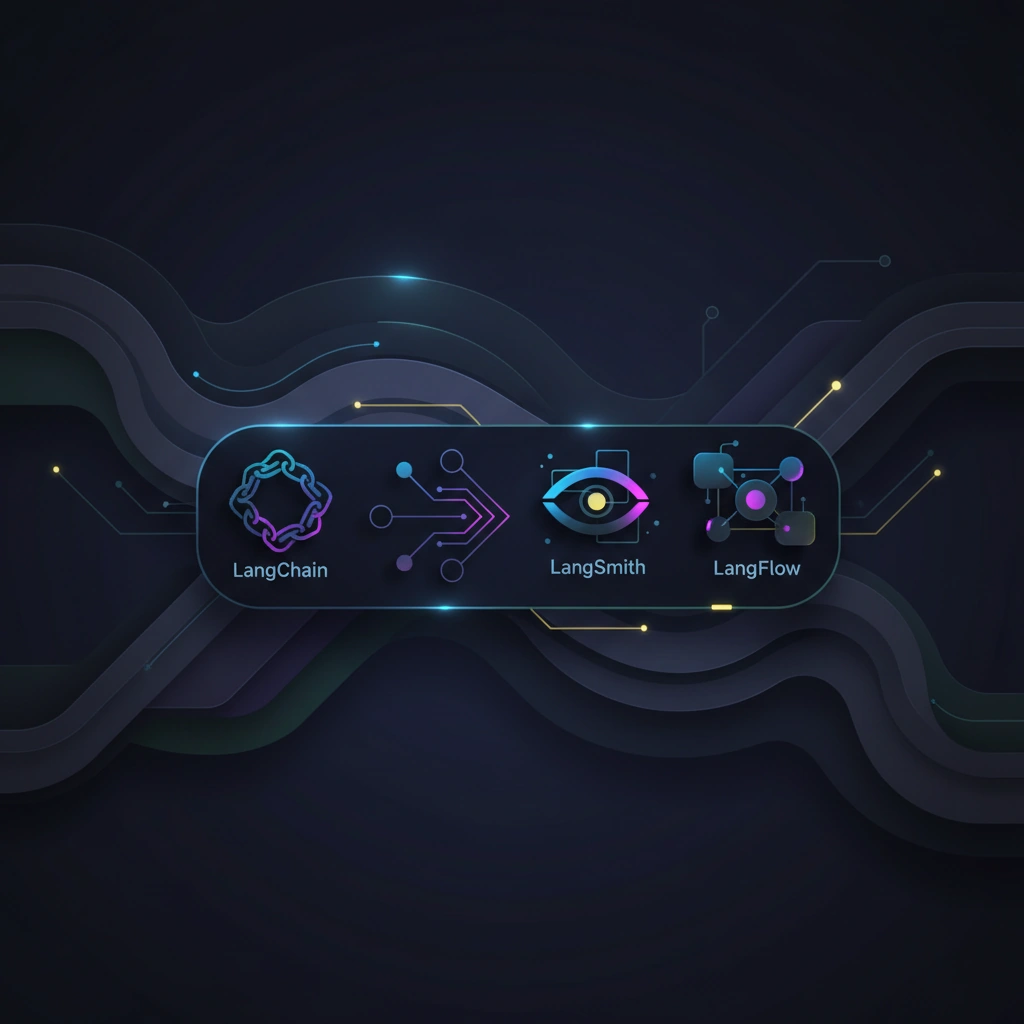
The rapid evolution of large language model applications has spawned an ecosystem of development tools, with the LangChain family standing at the forefront. For developers building AI systems—whether chatbots, content generation pipelines, or synthetic media workflows—understanding when to use LangChain versus LangGraph versus LangSmith versus LangFlow can mean the difference between a smooth development process and unnecessary complexity.
LangChain: The Foundation Framework
LangChain serves as the foundational framework for building LLM-powered applications. At its core, LangChain provides abstractions for connecting language models to external data sources, APIs, and tools through a concept called "chains"—sequences of operations that process inputs and produce outputs.
The framework excels at rapid prototyping and straightforward LLM applications. Key components include:
Prompt Templates: Reusable structures for formatting inputs to language models, supporting variable injection and conditional logic.
Chains: Composable sequences that link multiple LLM calls or tool invocations together, from simple sequential chains to more complex routing logic.
Agents: Dynamic systems where the LLM decides which tools to use based on user input, enabling more flexible application behavior.
Memory: Mechanisms for maintaining conversation context across multiple interactions, crucial for chatbot and assistant applications.
LangChain is ideal when you need to quickly connect an LLM to external data sources, build straightforward question-answering systems, or create applications with predictable, linear workflows.
LangGraph: Stateful Multi-Agent Orchestration
LangGraph extends LangChain's capabilities for applications requiring complex, stateful workflows with multiple agents. Built on a graph-based architecture, LangGraph treats your application as a state machine where nodes represent computational steps and edges define transitions between states.
The key differentiator is LangGraph's approach to cycles and state persistence. While LangChain chains are typically acyclic (data flows in one direction), LangGraph supports:
Cyclic Workflows: Agents can loop back to previous states, enabling iterative refinement processes essential for tasks like code generation with testing or content creation with revision cycles.
Persistent State: Built-in checkpointing allows workflows to be paused, resumed, and even time-traveled for debugging.
Human-in-the-Loop: Native support for pausing execution to await human approval or input before proceeding.
Multi-Agent Coordination: Multiple specialized agents can collaborate, with the graph structure managing their interactions and shared state.
For AI video generation pipelines—where you might have separate agents handling script generation, scene planning, visual asset creation, and quality validation—LangGraph's stateful orchestration provides the architectural foundation for complex, iterative workflows.
LangSmith: Observability and Evaluation
LangSmith addresses a critical gap in LLM development: understanding what your application is actually doing. As a dedicated observability and evaluation platform, LangSmith provides tools for debugging, testing, and monitoring LLM applications in development and production.
Core capabilities include:
Tracing: Detailed logs of every LLM call, tool invocation, and chain execution, with latency metrics and token usage tracking. This visibility is invaluable when debugging why a synthetic media generation pipeline produced unexpected results.
Evaluation Frameworks: Systematic approaches to measuring LLM output quality through custom evaluators, reference-based comparisons, and LLM-as-judge patterns.
Dataset Management: Tools for curating test datasets and running regression tests against application changes.
Production Monitoring: Real-time dashboards tracking application performance, error rates, and usage patterns.
For teams deploying AI content generation systems, LangSmith's evaluation capabilities help ensure output quality remains consistent—critical when generated content faces public scrutiny or authenticity verification.
LangFlow: Visual Development Interface
LangFlow takes a different approach entirely, providing a visual, drag-and-drop interface for building LLM applications. Rather than writing code, developers construct workflows by connecting pre-built components on a canvas.
The platform targets:
Rapid Prototyping: Non-developers or teams exploring LLM capabilities can quickly assemble working prototypes without deep Python knowledge.
Visual Debugging: Seeing the entire workflow laid out graphically makes it easier to identify bottlenecks or logical errors.
Component Reusability: Workflows can be saved, shared, and composed into larger systems.
Code Export: Visual workflows can be exported to Python code for further customization or production deployment.
LangFlow suits teams with mixed technical backgrounds or organizations wanting to democratize LLM experimentation across departments.
Choosing the Right Tool
The decision framework is relatively straightforward:
Use LangChain when building applications with predictable workflows, connecting LLMs to data sources, or needing maximum flexibility through code.
Use LangGraph when your application requires complex state management, multiple agents collaborating, human-in-the-loop approval flows, or iterative refinement cycles.
Use LangSmith alongside either framework when you need visibility into application behavior, systematic evaluation of outputs, or production monitoring.
Use LangFlow for rapid visual prototyping, enabling non-developers to experiment, or when you prefer graphical workflow construction.
Many production systems combine these tools: LangGraph for orchestration logic, LangChain components within graph nodes, and LangSmith providing observability across the entire system. Understanding each tool's strengths ensures you're building on the right foundation for your specific AI application requirements.
Stay informed on AI video and digital authenticity. Follow Skrew AI News.