HaluNet: Multi-Granular Uncertainty for LLM Hallucination Detecti
New research introduces HaluNet, a framework using multi-granular uncertainty modeling to efficiently detect hallucinations in LLM question answering systems.
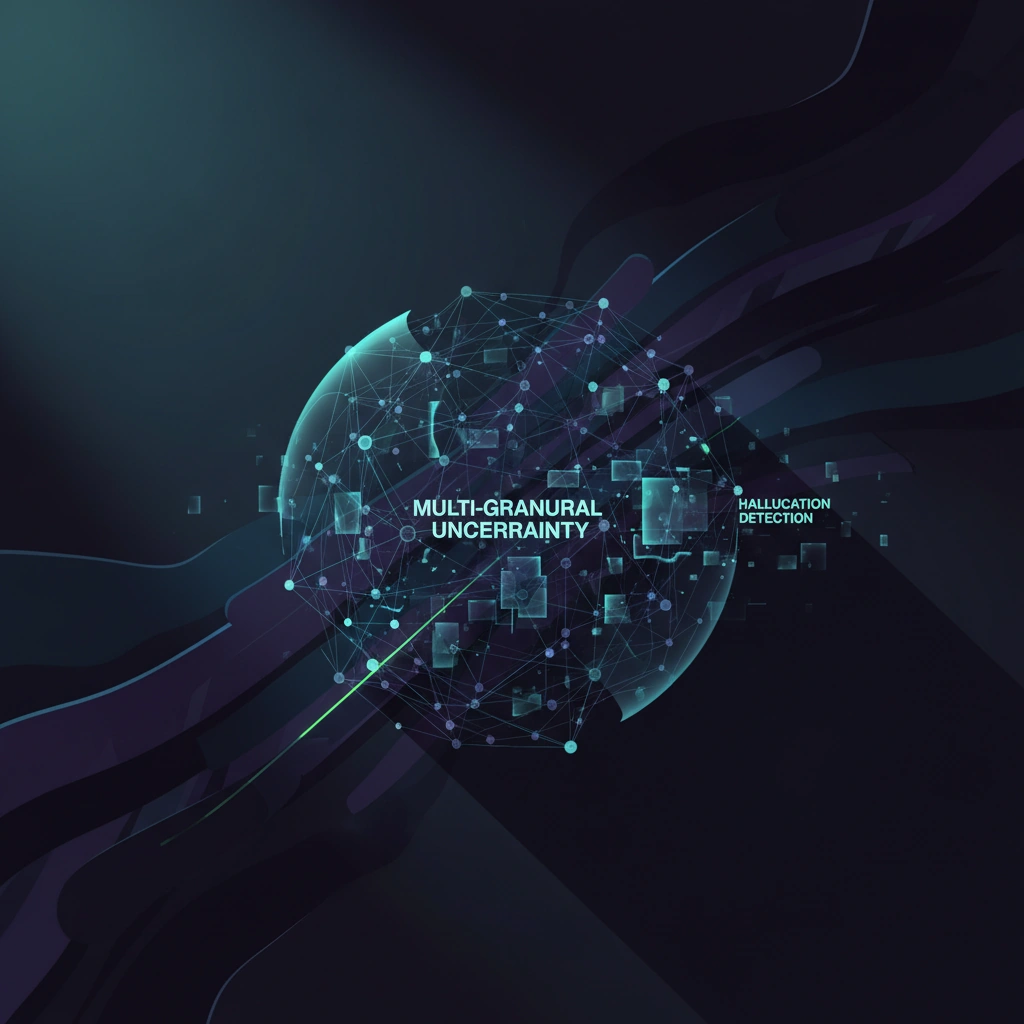
A new research paper introduces HaluNet, a novel framework designed to tackle one of the most pressing challenges in modern AI systems: detecting when large language models generate false or fabricated information. The research presents a multi-granular uncertainty modeling approach that promises more efficient and accurate hallucination detection in question-answering applications.
The Hallucination Problem in LLMs
As large language models become increasingly integrated into critical applications—from content generation to decision support systems—the issue of hallucination has emerged as a fundamental barrier to trust. When LLMs confidently generate plausible-sounding but factually incorrect information, the consequences can range from minor inconveniences to serious misinformation spread.
Traditional approaches to hallucination detection often rely on either external knowledge bases for fact-checking or simple confidence thresholds that fail to capture the nuanced nature of model uncertainty. HaluNet takes a fundamentally different approach by examining uncertainty at multiple granularities within the model's processing pipeline.
Multi-Granular Uncertainty Modeling
The core innovation of HaluNet lies in its multi-granular architecture that captures uncertainty signals at different levels of the language model's generation process. Rather than treating uncertainty as a single scalar value, the framework models it across token-level, sequence-level, and semantic-level dimensions.
At the token level, HaluNet analyzes the probability distributions over the vocabulary at each generation step, identifying moments where the model exhibits unusual entropy patterns that may indicate uncertainty. The sequence-level analysis examines how these uncertainties compound and propagate through the generated response, while semantic-level modeling considers the broader meaning and coherence of the output.
This hierarchical approach allows the system to distinguish between different types of uncertainty: epistemic uncertainty (what the model doesn't know) and aleatoric uncertainty (inherent ambiguity in the question or domain). This distinction is crucial for practical deployment, as it helps identify which hallucinations stem from knowledge gaps versus those arising from ambiguous queries.
Efficiency Considerations
One of HaluNet's key contributions is its focus on computational efficiency. Many existing hallucination detection methods require multiple inference passes, external API calls to verification services, or heavyweight ensemble approaches. The multi-granular uncertainty framework is designed to extract uncertainty signals during a single forward pass, making it practical for real-time applications.
The architecture leverages internal model representations that are already computed during standard inference, adding minimal overhead while providing rich uncertainty information. This efficiency is particularly important for deployment scenarios where latency constraints are strict or computational resources are limited.
Implications for Digital Authenticity
The research has significant implications beyond question-answering systems. As generative AI becomes more prevalent in creating synthetic media—from AI-generated text to video narration and voice synthesis—the ability to detect unreliable outputs becomes essential for maintaining digital authenticity.
Hallucination detection in LLMs shares conceptual foundations with deepfake detection: both involve identifying when AI-generated content deviates from truth or reality. The uncertainty modeling techniques developed for HaluNet could potentially inform approaches to detecting synthetic media that contains fabricated elements, even when the generation quality is high.
Applications in Content Verification
For platforms dealing with AI-generated content, frameworks like HaluNet offer a pathway toward automated quality assurance. By flagging responses with high uncertainty scores, systems can route questionable content for human review or request additional verification before publication.
This is particularly relevant for news organizations, educational platforms, and enterprise applications where factual accuracy is paramount. The multi-granular approach provides not just a binary reliable/unreliable classification, but nuanced signals about which aspects of a response may require scrutiny.
Technical Architecture
The HaluNet architecture integrates uncertainty quantification modules directly into the transformer's attention layers. By analyzing attention patterns and hidden state dynamics, the system can identify when the model is relying on weak or inconsistent evidence to generate its responses.
The framework employs uncertainty aggregation networks that learn to combine signals from different granularities into actionable hallucination probability scores. These networks are trained on datasets containing both faithful and hallucinated responses, learning the subtle patterns that distinguish reliable from unreliable generation.
Future Directions
The research opens several avenues for future work, including extension to multimodal settings where LLMs process images or audio alongside text. As vision-language models become more prevalent in synthetic media applications, the ability to detect hallucinations across modalities will become increasingly important.
The multi-granular uncertainty framework represents a significant step toward more trustworthy AI systems, providing the technical foundations for automated authenticity verification in an era of increasingly capable generative models.
Stay informed on AI video and digital authenticity. Follow Skrew AI News.