Generative AI as Threshold Logic in High Dimensions
A new arXiv paper reframes generative AI as threshold logic operating in high-dimensional space, offering foundational insights into how neural networks produce synthetic content.

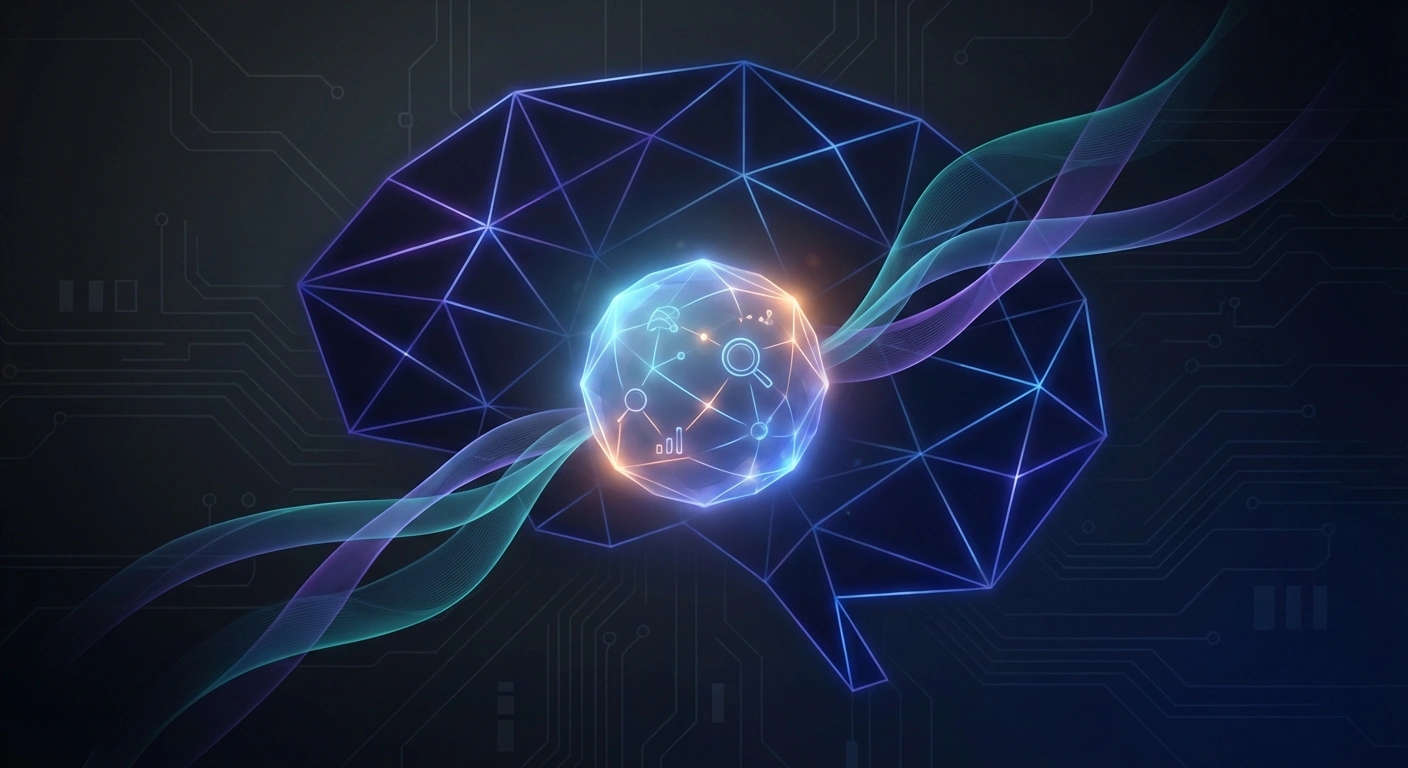
A new research paper published on arXiv, titled "Understanding the Nature of Generative AI as Threshold Logic in High-Dimensional Space," offers a compelling theoretical lens through which to understand how modern generative AI systems—from large language models to image and video generators—actually function at their most fundamental mathematical level. The paper reframes the operation of neural networks as threshold logic operating across high-dimensional geometric spaces, providing a unifying perspective that connects classical computational theory with the empirical behavior of today's most powerful AI systems.
Threshold Logic: A Classical Concept, Reimagined
Threshold logic is not a new idea. It dates back to the earliest days of neural network research, rooted in the McCulloch-Pitts neuron model from the 1940s and the perceptron work of the 1950s and 1960s. At its core, a threshold logic unit takes weighted inputs, sums them, and fires (outputs 1) if the sum exceeds a threshold—otherwise it outputs 0. Each such unit effectively carves high-dimensional input space with a hyperplane, dividing it into two regions.
What this paper argues is that the entire apparatus of modern generative AI—including transformers, diffusion models, and GANs—can be understood as sophisticated compositions of threshold logic units operating in extraordinarily high-dimensional spaces. Rather than treating deep learning as an opaque black box, the authors propose that analyzing these systems through the geometric lens of threshold functions and hyperplane arrangements reveals deep structural truths about how they learn and generate.
High-Dimensional Geometry and Generation
The key insight is geometric. In high-dimensional spaces, the behavior of threshold functions becomes both more powerful and more counterintuitive. The paper explores how layers of threshold logic units progressively partition input spaces into increasingly complex regions. Each layer adds expressive power by composing hyperplane cuts, allowing the network to represent intricate decision boundaries and probability distributions.
For generative models specifically, this framework helps explain how a model learns to map from a simple latent distribution (like Gaussian noise) to the complex manifold of realistic images, audio, or video. The generative process can be understood as a series of geometric transformations—each governed by threshold logic—that progressively sculpt noise into structured, high-dimensional outputs that we perceive as coherent synthetic content.
Implications for Synthetic Media and Detection
This theoretical perspective carries significant practical implications for the synthetic media and digital authenticity community. If generative AI is fundamentally performing threshold logic operations in high-dimensional space, then the artifacts and limitations of generated content are not random—they are geometric. They arise from the specific ways hyperplane arrangements partition the learned manifold.
This insight could inform new approaches to deepfake detection. Rather than relying solely on pixel-level or frequency-domain forensics, detection systems could potentially exploit the geometric regularities imposed by threshold logic architectures. Understanding which regions of high-dimensional space a generative model can and cannot convincingly represent could lead to more robust, architecture-aware detection methods that generalize across different generator types.
Additionally, this framework offers a more principled way to understand model capacity and failure modes. If we know that a model's expressiveness is bounded by its threshold logic depth and the dimensionality of its representations, we can better predict where synthetic content will break down—whether in temporal coherence for AI video, prosodic naturalness for voice cloning, or fine-grained texture fidelity for face generation.
Bridging Theory and Practice
The paper contributes to a growing body of work seeking to demystify deep learning through rigorous mathematical analysis. While much of the AI industry focuses on scaling—more parameters, more data, more compute—this research asks a more fundamental question: what is the computational nature of what these systems are doing?
For researchers building the next generation of generative models for video synthesis, face swapping, or voice cloning, this theoretical grounding can guide architectural decisions. For those working on content authentication and provenance verification, it provides a framework for understanding the inherent mathematical signatures that generative processes leave behind.
Looking Forward
As generative AI continues to produce increasingly convincing synthetic media, understanding the mathematical foundations becomes not just an academic exercise but a practical necessity. Papers like this one help bridge the gap between the theoretical computer science community and the applied world of AI safety, content authentication, and digital trust. The threshold logic perspective may prove to be a valuable tool in both building better generative systems and developing more effective defenses against their misuse.
Stay informed on AI video and digital authenticity. Follow Skrew AI News.