Deepfake Execs Hit Video Calls as Real-Time Detection Rises
Deepfake impersonators are joining live video meetings posing as executives, driving researchers to build real-time detection systems capable of flagging synthetic participants before fraud occurs.
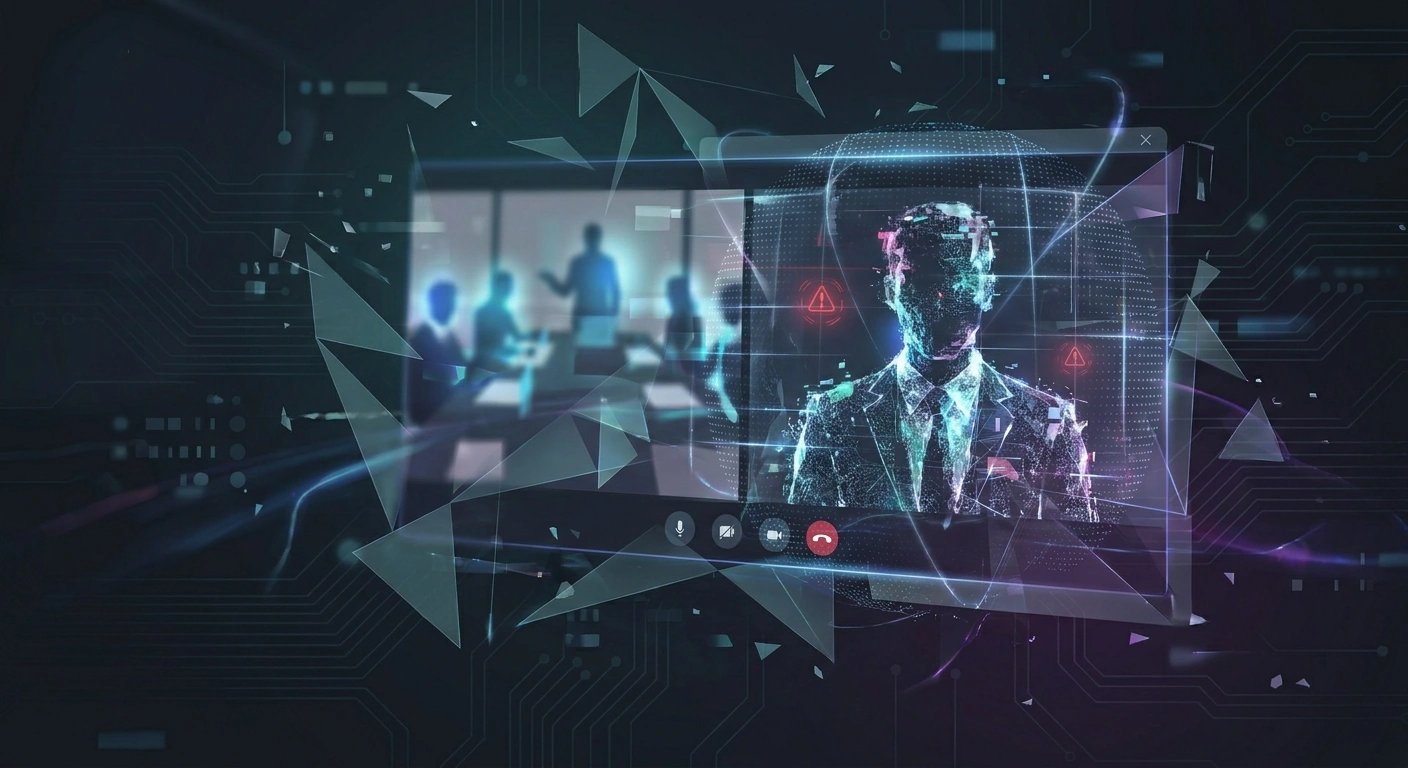
The corporate video call, once a mundane fixture of remote work, is becoming the newest frontier for AI-enabled fraud. According to recent reporting, deepfake impersonators are now joining live video meetings posing as company executives, exploiting the trust employees place in a familiar face on screen. In response, researchers are racing to develop real-time detection systems capable of flagging synthetic participants before financial or reputational damage is done.
From Static Deepfakes to Live Impersonation
Deepfake technology has historically been associated with pre-recorded, manipulated videos — a doctored clip of a politician, or a face-swapped celebrity. But the threat has evolved dramatically. Advances in real-time face-swapping, voice cloning, and low-latency generative rendering have made it feasible for an attacker to appear as someone else during a live call. This shift transforms deepfakes from a disinformation problem into an active, interactive social-engineering weapon.
The most infamous case to date remains the Hong Kong incident in which a finance worker was tricked into transferring roughly $25 million after joining a video conference populated entirely by deepfaked colleagues — including a synthetic version of the company's CFO. That single case crystallized what security researchers had warned about: the combination of live deepfakes plus authority impersonation is uniquely effective because it bypasses the skepticism that written phishing emails often trigger.
Why Video Meetings Are Vulnerable
Live impersonation attacks succeed because video conferencing platforms were never designed with identity verification as a core function. Anyone with a meeting link can join, and the visual and auditory cues that humans rely on to confirm identity — a familiar face, a recognizable voice, natural conversational rhythm — are precisely the elements that modern generative models can now replicate convincingly.
Attackers typically combine several techniques: a real-time face-swap engine mapped onto a live camera feed, a cloned voice model trained on publicly available audio (earnings calls, interviews, conference talks), and social-engineering scripts that create urgency. The relatively low resolution and compression artifacts inherent in video calls actually work in the attacker's favor, masking the subtle glitches that might otherwise reveal a synthetic face.
Building Real-Time Detection
The core challenge for defenders is latency. Traditional deepfake detection tools analyze video frame-by-frame after the fact, which is useless when a fraudulent transaction is being approved in the moment. Real-time detection systems must instead analyze the live stream continuously, flagging anomalies within milliseconds.
Researchers are pursuing several technical approaches. One category focuses on physiological signals — subtle indicators such as blood-flow-induced color changes in the skin (photoplethysmography), natural blinking patterns, and micro-expressions that current generative models struggle to reproduce consistently. Another approach examines temporal inconsistencies: the way lighting interacts with a real face across frames, the coherence between head movement and facial geometry, and lip-sync fidelity between audio and visual streams.
A third line of defense leverages frequency-domain analysis, hunting for the spectral fingerprints that generative adversarial networks and diffusion models leave behind — artifacts invisible to the human eye but detectable through signal processing. Combining these signals into an ensemble model improves robustness, since an attacker would need to defeat multiple independent detectors simultaneously.
The Detection Arms Race
The uncomfortable reality is that detection and generation are locked in a perpetual arms race. As detection models learn to spot a particular artifact, generative systems are retrained to eliminate it. This dynamic means no single detection method offers a permanent solution. Effective defense will likely require a layered strategy: real-time technical detection combined with procedural safeguards such as out-of-band verification for high-value transactions, multi-factor identity confirmation, and employee training on the existence of live deepfake threats.
For enterprises, the strategic takeaway is clear. Video presence can no longer be treated as proof of identity. Organizations handling sensitive approvals should assume that any face on a screen could be synthetic and build verification protocols accordingly. Meanwhile, the emergence of real-time detection tools signals a growing market for authenticity infrastructure — the kind of technology that verifies not just documents and images, but live human presence itself.
As generative video continues to improve, the meeting room — physical or virtual — is becoming a battleground for digital authenticity. Real-time detection may prove to be one of the most consequential defenses of the deepfake era.
Stay informed on AI video and digital authenticity. Follow Skrew AI News.