FPGA-Based CXL Memory Architecture Tackles LLM KV-Cache Bottlenec
New research proposes CXL-SpecKV, a disaggregated FPGA architecture using CXL memory pooling and speculative prefetching to overcome memory bottlenecks in large language model inference at datacenter scale.
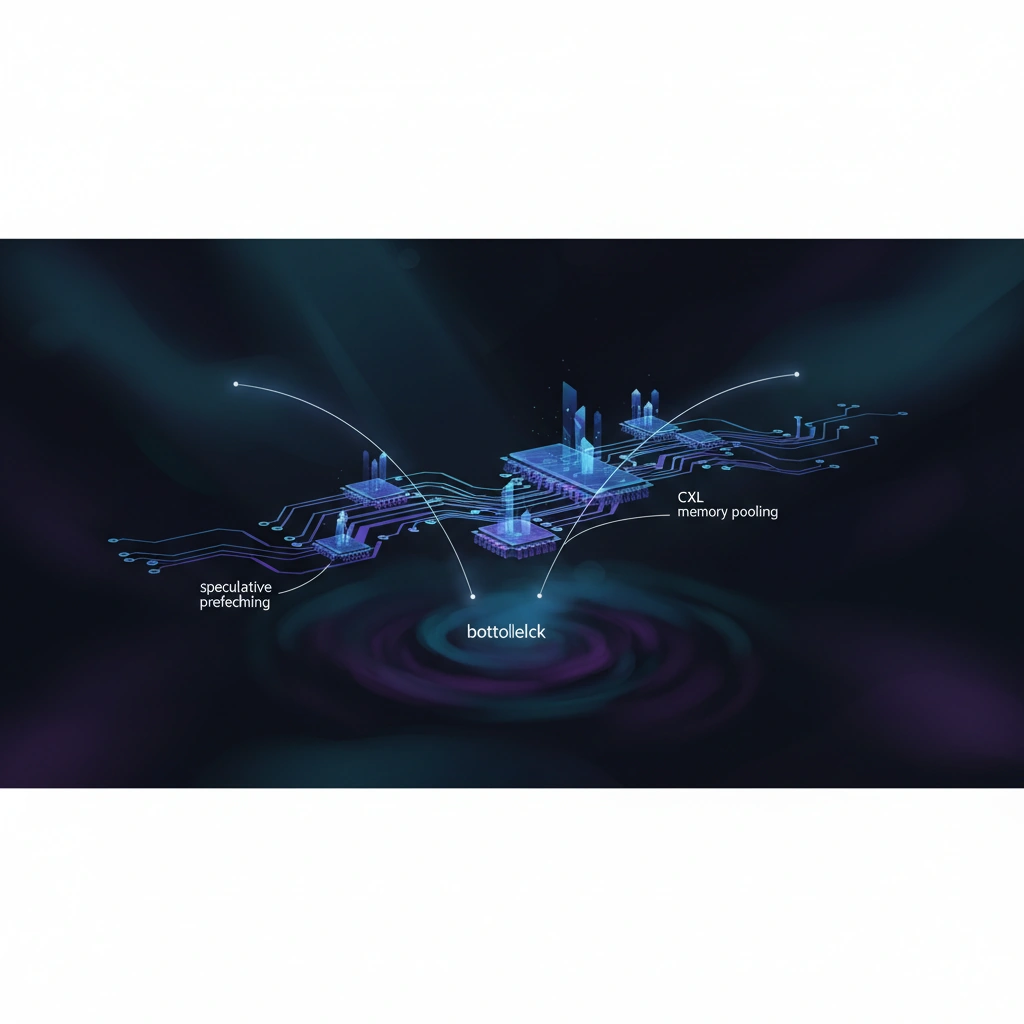
A new research paper introduces CXL-SpecKV, an innovative hardware architecture that addresses one of the most pressing challenges in large-scale AI deployment: the memory bottleneck created by key-value caches during large language model inference. The approach combines Compute Express Link (CXL) memory disaggregation with FPGA-accelerated speculative prefetching to enable more efficient datacenter LLM serving.
The KV-Cache Memory Challenge
As large language models grow in size and capability, the key-value (KV) cache has emerged as a critical performance bottleneck. During autoregressive generation, LLMs must store and access attention key-value pairs from all previous tokens, creating memory requirements that grow linearly with sequence length. For modern models handling long contexts—essential for video understanding, multimodal synthesis, and extended creative generation—this memory pressure becomes acute.
Traditional approaches keep KV-caches in GPU high-bandwidth memory (HBM), but this strategy faces severe limitations. GPU memory is expensive, limited in capacity, and creates resource contention during multi-tenant serving. As AI video generation systems and synthetic media pipelines demand increasingly long context windows, the industry needs new architectural solutions.
CXL Memory Disaggregation Explained
Compute Express Link (CXL) represents a paradigm shift in datacenter architecture. This open interconnect standard enables memory pooling across multiple hosts, breaking the traditional constraint where each server's memory is siloed to its own CPUs and accelerators. CXL allows heterogeneous compute resources to access shared memory pools with cache-coherent semantics.
The CXL-SpecKV architecture leverages this capability to move KV-cache storage from expensive GPU memory to disaggregated CXL-attached memory pools. This approach offers multiple advantages: dramatically increased memory capacity, better resource utilization across multi-tenant deployments, and reduced cost per gigabyte of available KV storage.
Speculative Prefetching with FPGA Acceleration
The critical innovation in CXL-SpecKV lies in its speculative prefetching mechanism implemented on FPGA hardware. Moving KV-caches to CXL memory introduces latency penalties compared to local HBM access. To mitigate this, the system predicts which KV entries will be needed for upcoming inference steps and prefetches them before they're required.
The FPGA implementation enables several key capabilities:
Low-latency speculation: FPGAs provide deterministic, microsecond-scale response times for prefetch decisions, essential for keeping pace with GPU computation.
Parallel prefetch execution: The reconfigurable fabric can issue multiple memory requests simultaneously, hiding latency through parallelism.
Custom prediction logic: Unlike fixed-function accelerators, FPGAs allow experimentation with different speculation algorithms tailored to specific workload patterns.
Implications for AI Video and Synthetic Media
This research carries significant implications for the AI video generation and synthetic media space. Modern video synthesis models like Sora, Runway's Gen-3, and similar systems require processing long sequences of visual tokens. The attention mechanisms in these models create massive KV-cache requirements that scale with video length and resolution.
By enabling efficient KV-cache disaggregation, architectures like CXL-SpecKV could unlock:
Longer video generation: Extended context windows without memory exhaustion enable coherent multi-minute video synthesis.
Higher resolution output: More memory headroom allows processing of higher-resolution visual tokens.
Multi-tenant efficiency: Shared memory pools reduce per-user infrastructure costs, making AI video services more economically viable.
Real-time applications: Reduced memory pressure could enable interactive video generation and deepfake detection systems with faster response times.
Technical Architecture Considerations
The CXL-SpecKV design must balance several competing factors. CXL 2.0 and 3.0 specifications offer different bandwidth and latency characteristics, affecting prefetch effectiveness. The speculation algorithm must achieve high prediction accuracy—mispredicted prefetches waste memory bandwidth and can actually degrade performance.
The FPGA component handles the critical path of monitoring GPU inference progress, predicting future KV access patterns, and issuing timely prefetch requests to the CXL memory controller. This requires tight integration between the prediction logic, memory subsystem, and GPU driver stack.
Broader Industry Context
This research reflects growing industry attention to memory-centric AI infrastructure. As Nvidia's dominance in AI accelerators continues, alternative approaches to scaling AI workloads—including CXL memory pooling and specialized accelerators—are gaining interest from hyperscalers and AI infrastructure providers.
For organizations deploying large-scale AI services, including video generation platforms and content authenticity systems, memory architecture innovations like CXL-SpecKV could significantly impact total cost of ownership and system capabilities. The research represents an important step toward more efficient and scalable AI infrastructure.
Stay informed on AI video and digital authenticity. Follow Skrew AI News.